
Low-noise decoy signals for fast review.
Decoys are a tripwire for attacker activity. When something touches one, you get a scoped signal with the context needed to review and route the incident.
Deception activity
See Dralvia in action.
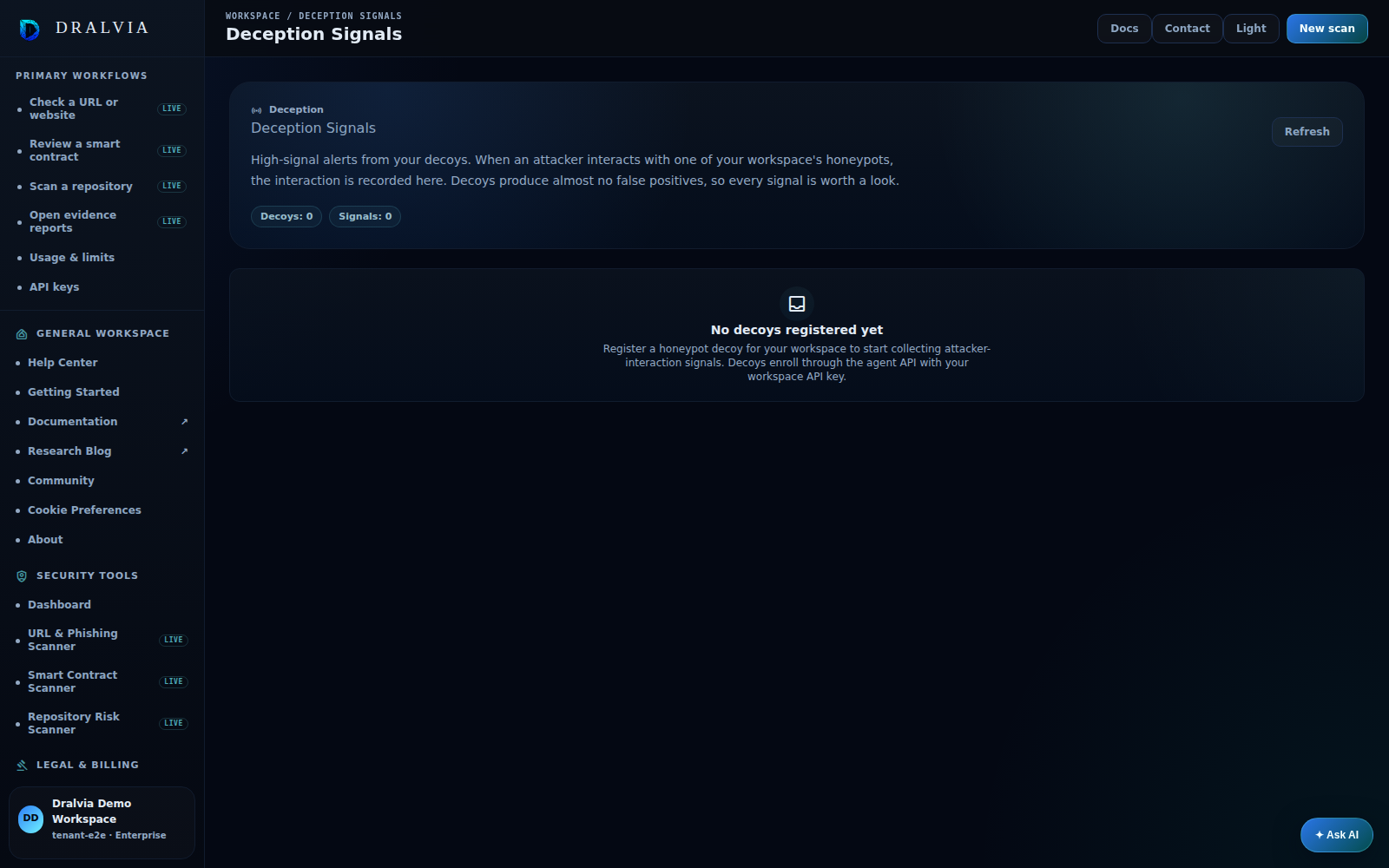
See workspace-scoped decoy interactions and move meaningful signals into an investigation.
- Deploy supported deception controls
- Observe interaction signals
- Escalate evidence into investigation
This preview shows the Dralvia workspace. Sign in to see your own scans, alerts, and activity.
Catch what prevention misses.
Deception fires after suspicious movement reaches a decoy, with a focused signal that broad telemetry can miss.
Decoy touched
Any interaction with a decoy is a signal worth acting on.
Interaction detail
Event type, request method and path, hashed source, and risk tags.
Low-noise source
Decoys are not normal user destinations, so each signal deserves review.
Register, wait, respond.
Register decoys
Enroll decoys for your workspace through the agent API.
Get signals
Any interaction with your decoys shows up as a scoped alert.
Respond
Triage the interaction and route it to your incident workflow.
Low-noise, scoped, automatable.
Workspace-scoped
You only ever see interactions with your own decoys.
Review-ready signal
A signal means something touched a decoy, which should not happen in normal use.
API + SIEM
Pull signals via GET /api/deception/signals into a SIEM or TicketBridge.
Security and response teams.
Responders
A low-noise tripwire that flags attacker activity worth investigating.
Security engineers
Place decoys near sensitive assets to widen coverage.
Honest answers.
No. The signals feed is strictly scoped to your workspace's decoys.
Add a low-noise tripwire.
Turn decoys into low-noise alerts scoped to your workspace.