
A domain has a history. Read it first.
Before you allowlist a partner, onboard a vendor, or approve an outbound integration, look up the domain. Dralvia returns a structured reputation verdict in seconds, drawing on registrar history, DNS posture, mail configuration, sibling lookalikes, and reputational drift.
Domain checks
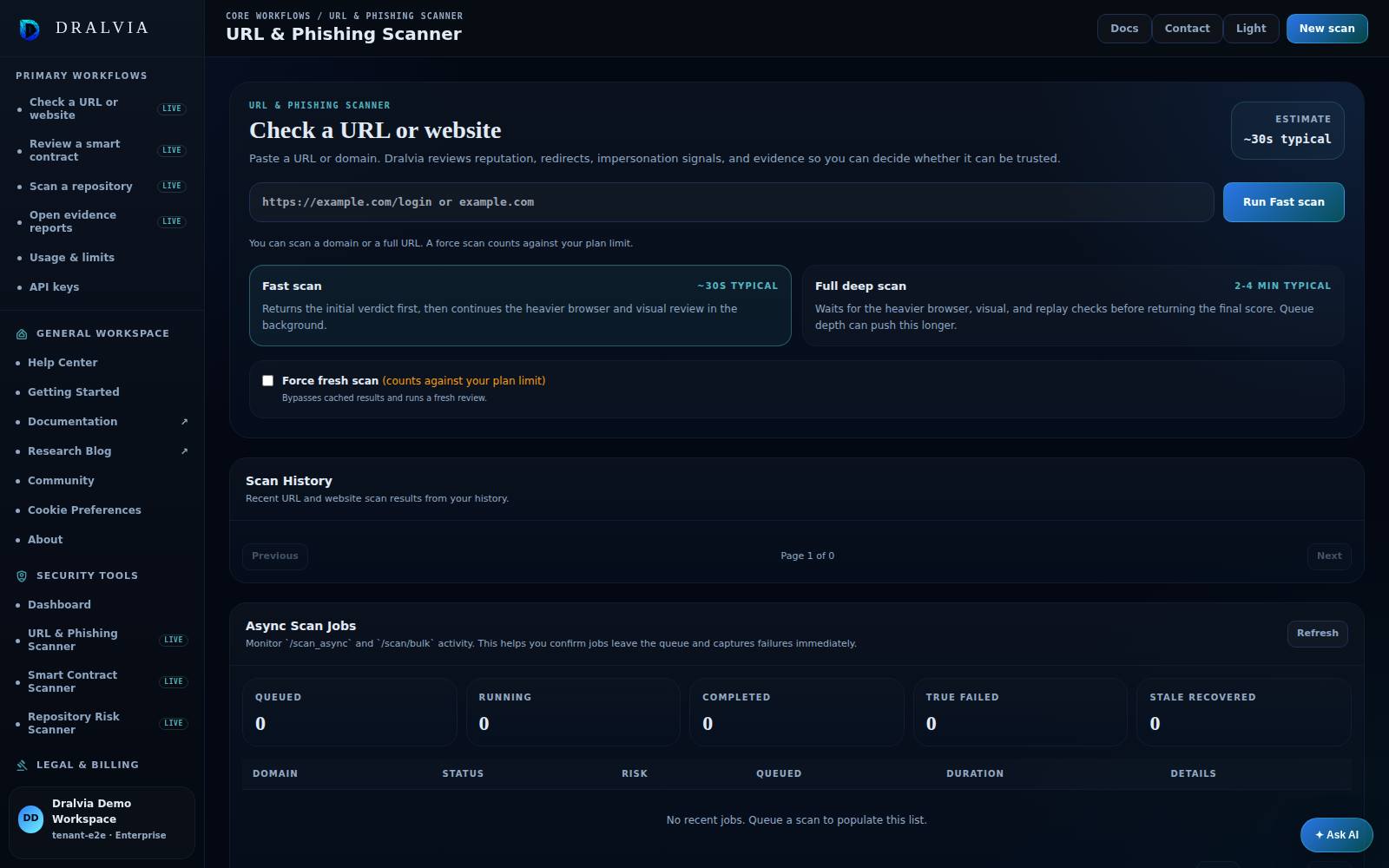
See Dralvia in action.
Check reputation, redirects, infrastructure, and signs of impersonation before trusting a domain.
- Start with a domain or full URL
- Review reputation and redirect evidence
- Re-run when fresh evidence is required
This preview shows the Dralvia workspace. Sign in to see your own scans, alerts, and activity.
Infrastructure risk, in seconds.
Domain reputation scores the underlying infrastructure, registrar, DNS, hosting, lookalikes, and history, cross-referenced with threat feeds and Dralvia's own crawler.
Registration profile
Registrar reputation, registration date, expiration runway, renewal pattern, privacy-proxy use, and payment-method signals where exposed.
Historical ownership
Past WHOIS observations, ownership transitions, expired-then-grabbed patterns, and recent re-registration after a drop-deletion.
DNS posture
NS provider, A / AAAA stability, fast-flux indicators, CNAME chains, TXT records, and whether SPF / DKIM / DMARC are present and well-formed.
Hosting reputation
IP and ASN reputation, hosting-provider abuse history, geographic anomalies, and clustering with other domains on the same infrastructure.
Sibling lookalike map
Domains within 1 to 2 edit distance, brand homoglyph variants, and shared phishing-kit fingerprints, surfaced as a connected graph.
Threat-feed cross-reference
Live cross-check against multiple intel feeds plus Dralvia's autonomous crawler that fingerprints freshly minted infrastructure.
Reputational drift
How the verdict has changed over time. A domain that used to score safe and now does not is a different signal from one that was always risky.
Categorisation & content
Site category, language, login surfaces present, and content hashes checked against known phishing-kit templates.
Look up the domain before you trust it.
Enter a domain
Dralvia gathers registrar, DNS, hosting, and mail records and assembles the historical picture.
Infrastructure + history
Reputation signals, lookalike clustering, and threat-feed cross-reference combine into one verdict, each source cited.
Trust posture you can act on
A clear verdict for the vendor review, plus monitoring so you hear about it when the domain's posture changes.
Honest answers.
URL scanning checks a specific page, content, redirect chain, and forms. Domain reputation scores the underlying infrastructure, registrar, DNS, hosting, lookalikes, mail configuration, and history. You typically run both: domain reputation for trust posture, URL scan for "is this exact link going to phish someone right now."
Check a domain before you onboard it.
Run a reputation lookup, read the infrastructure and lookalike signal, and keep monitoring after the review.
A domain is one layer of trust.
Scan the exact link
Content, redirect chain, and form analysis for a specific URL on the domain.
Vet inbound senders
Sender domains, lookalikes, and link posture for email-borne threats.
Vet the vendor's code
Leaked secrets, risky dependencies, and supply-chain signals across a repository.