
Decide before you click.
Paste a URL. Dralvia returns a verdict in seconds, with the exact signals that triggered it, no black box, no "the model says trust me." Every finding is traceable, exportable, and ready for the next analyst on the rotation.
URL scanning
See Dralvia in action.
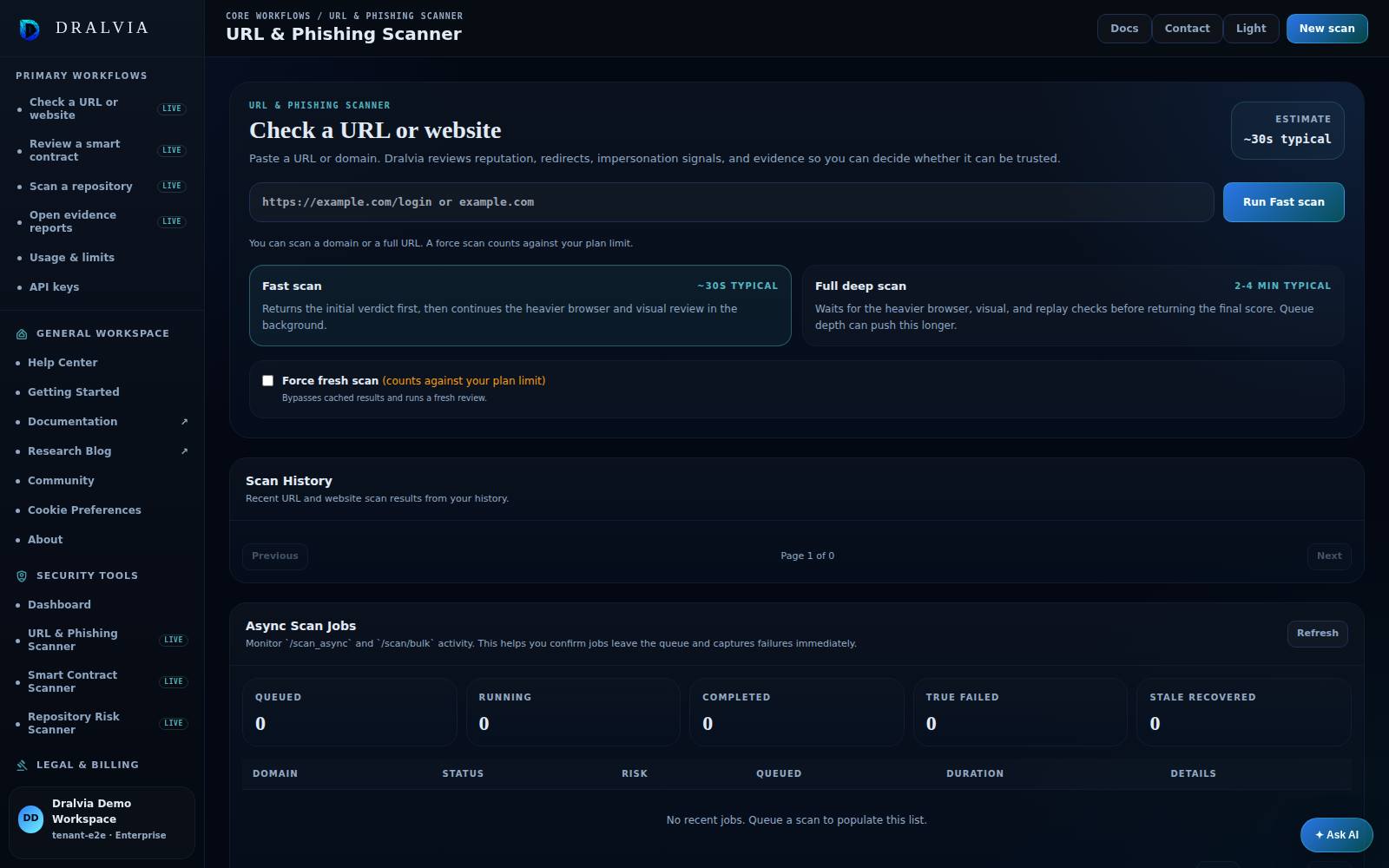
Submit a URL, choose the scan depth, and follow progress and results from one place.
- Paste a URL or domain
- Choose fast or deep review
- Follow the queue and result history
This preview shows the Dralvia workspace. Sign in to see your own scans, alerts, and activity.
100+ signals. One verdict. A full chain of custody.
Every verdict is the sum of evidence, not a probability from a model you cannot inspect. Here is what Dralvia checks on a single URL.
Typosquatting & brand impersonation
Damerau-Levenshtein distance, homoglyph substitution (Cyrillic / Latin), subdomain abuse, and IDN punycode unwrapping checked against a brand watchlist.
Domain age & registration
Registration date, registrar reputation, privacy-proxy use, and recent ownership changes, newly registered lookalikes are flagged immediately.
DNS & infrastructure
A / AAAA / NS / MX consistency, shared-host clustering, IP reputation, and reverse-DNS sanity to spot disposable hosting.
TLS & certificate
Issuer, SAN list, validity window, certificate-transparency log appearances, and certificate reuse across known-malicious siblings.
Redirect-chain capture
Hop-by-hop unwrap of meta-refresh, JavaScript, and 30x redirects, with every intermediate URL re-scored, the final destination is never trusted just because it looks clean.
Page content & form analysis
Cloned login pages, credential-exfil endpoints, hidden fields, and known phishing-kit fingerprints.
Threat-intel cross-reference
Live cross-check against OpenPhish, PhishTank, and URLhaus, plus Dralvia's own continuous crawl of new infrastructure.
Behaviour history
How the domain has scored over time, how often it has been queried, and whether the verdict has changed since the last scan.
From paste to verdict in seconds.
Paste anything URL-shaped
Full URL, root domain, shortlink, redirector, or a deep query path. Dralvia normalises and detects the input type before routing.
100+ checks run in parallel
Network probes, content fetches, threat-intel cross-checks, and classifiers fire concurrently. Each is timeboxed and independently scored.
Score, evidence, action
A clear risk verdict, structured findings, redirect capture, and a one-click EvidencePack (PDF or JSON). Block, monitor, or share from the same screen.
Phishing triage that ends in an action, not another tab.
A permalink for every result
Each scan gets a stable link. Hand it to the next analyst, drop it in chat, or attach it to a ticket, the verdict reproduces with full evidence.
Redirect-chain unwrap
Shortlinks, meta-refresh, JavaScript hops, and tracker bounces are followed and re-scored. A clean-looking final page is never trusted on its own.
Pattern memory
If a kit you have seen before reappears at a new domain, Dralvia surfaces it, phishing-kit fingerprints, shared infrastructure, and recycled login pages all cluster.
Continuous monitoring
Add a target to watch. Dralvia re-scans on a schedule and alerts via email or webhook when the verdict changes, useful for brand monitoring and IR.
EvidencePack export
Every finding, signal, header dump, and redirect capture bundled into a single artifact, for compliance, customer comms, and IR handoff.
API + SDKs
The same engine is available as a REST API and Python / JavaScript SDKs. Pipe gateway, ticketing, or browser-extension events into Dralvia and bring verdicts back inline.
For people who need the verdict, not the lecture.
SOC analysts
Triage user-reported emails in seconds. The verdict, signal trail, and EvidencePack become the ticket body, no more screenshots and narration.
IT & help desk
Paste the URL a user clicked. Get a one-page verdict you can show them, plus an artifact your security lead can audit later.
Managed service providers
Per-workspace scoping, API access, and brand-monitor alerts. Wrap Dralvia into your own portal, or run it standalone for client triage.
Honest answers.
Dralvia is a verdict and evidence engine that returns a structured risk decision you can act on. Inline blocking is delivered through the Dralvia browser extension and Secure Web Gateway, both live today. For most teams the API plus extension combination is the path to in-line enforcement.
Scan your first suspicious URL.
No account required for your first analysis. Paste a URL, see the full evidence chain, and decide whether it leaves your inbox.
A URL is rarely the only thing to check.
Check the domain itself, not just the URL
Registrar, hosting history, mail server, sibling lookalikes, and reputational drift over time.
Scan code before you trust it
Leaked secrets, risky dependencies, and supply-chain signals across a repository.
Review a contract before you sign
Static analysis, verified-source checks, and risk heuristics before funds move.